Plastic components have become essential across automotive, electrical, electronics,
medical, packaging, consumer goods, machinery, and general industrial applications.
Among the different plastic manufacturing processes available today,
plastic injection moulding is widely used for producing complex, repeatable,
and accurately manufactured components in large quantities.
For OEMs and industrial buyers, selecting the correct plastic material, mould
design, manufacturing process, and production partner can significantly influence
component quality, durability, cost, and overall product performance.
What Is Plastic Injection Moulding?
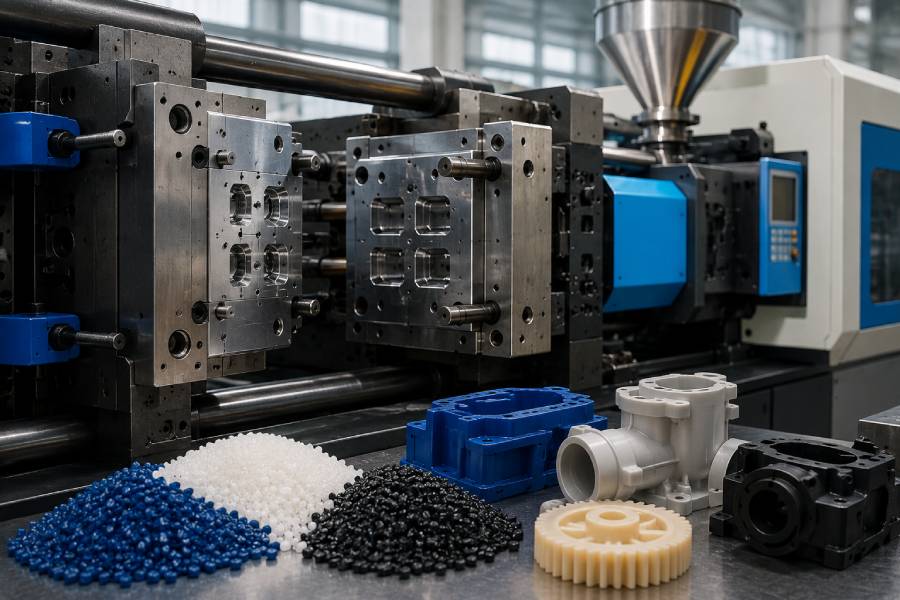
Plastic injection moulding is a manufacturing process in which plastic material is
heated until it reaches a suitable molten state and is then injected into a
specially designed mould cavity. After cooling and solidification, the mould opens
and the finished component is removed.
The process can manufacture components ranging from relatively simple plastic parts
to complex OEM components containing detailed geometries, ribs, bosses, holes,
mounting features, and other functional elements.
Once the mould and manufacturing parameters have been properly established,
injection moulding provides excellent repeatability for volume production.
Why Is Injection Moulding Popular for OEM
Components?
One of the biggest advantages of injection moulding is its ability to manufacture
large quantities of components with consistent dimensions and geometry.
OEM manufacturers often require thousands of identical parts for assemblies.
Variations between components can create problems during assembly or affect the
performance of the finished product. A controlled moulding process helps maintain
consistency throughout production.
Injection moulding also provides significant design flexibility. Depending on
component requirements, manufacturers can develop customized moulds according to
engineering drawings, samples, dimensions, and application specifications.
Selecting the Right Plastic Material
Material selection is a critical stage of plastic component development. Different
plastics offer different combinations of strength, flexibility, chemical resistance,
impact resistance, temperature stability, dimensional stability, and cost.
Common engineering materials include:
- ABS for good impact resistance and surface
finish
- Polypropylene (PP) for lightweight and
chemical-resistant components
- HDPE for strong and moisture-resistant
applications
- LDPE for flexible components
- PVC for durable and corrosion-resistant
applications
- Nylon for wear-resistant mechanical
components
- Polycarbonate for applications requiring
high impact strength
- Delrin/Acetal for precision engineering
components with low friction
- PTFE for chemical resistance and
higher-temperature applications
The final selection should always consider the actual working conditions of the
component.
Injection Moulding vs Extrusion and Blow
Moulding
Not every plastic component should be injection moulded.
Plastic extrusion moulding is commonly suitable for continuous profiles,
tubes, sheets, and similar products where a consistent cross-sectional shape is
required.
Blow moulding, meanwhile, is commonly used to manufacture hollow products
such as bottles, containers, tanks, and other lightweight hollow structures.
Injection moulding is generally preferred when manufacturers need individual
components with complex three-dimensional geometries and repeatable features.
Understanding these differences helps OEMs avoid selecting an inefficient production
method.
Importance of Mould Design
The quality of an injection-moulded component begins before production starts. Mould
design plays an important role in determining dimensional accuracy, surface quality,
production efficiency, and consistency.
Engineers must consider factors such as component geometry, wall thickness, draft
angles, shrinkage, gate positioning, material flow, cooling, and ejection.
A poorly planned mould can result in defects or inconsistent components. Therefore,
reviewing the product design for manufacturability before mould development can save
considerable time and cost later.
Quality Control in Plastic Component
Manufacturing
Quality assurance should be maintained throughout the manufacturing process.
Manufacturers may inspect dimensions, surface condition, material consistency,
fitment, visual appearance, and other application-specific characteristics. For
precision OEM components, maintaining repeatability across different production
batches is especially important.
Shiv Sai Export & Import supports plastic moulding requirements for domestic and
international markets, including customized and bulk production based on customer
drawings, samples, and technical specifications.
Benefits of Outsourcing Plastic Moulding
Parts from India
India has developed a broad manufacturing ecosystem capable of supporting customized
plastic components and other engineered products.
For international OEMs, sourcing from India can provide access to engineering
capabilities, diverse manufacturing processes, customized development, competitive
production, and export support.
However, successful outsourcing requires more than simply identifying a
manufacturer. Buyers must also manage technical communication, quality checks,
production schedules, packaging, documentation, and international logistics.
Working with an experienced outsourcing and export partner can simplify these
activities.
Plastic Moulding Solutions from Shiv Sai
Export & Import
Shiv Sai Export & Import provides access to plastic injection moulding, plastic
extrusion moulding, and plastic blow moulding capabilities as part
of its broader outsourced manufacturing portfolio. Its services also extend to
sheet metal and deep draw parts,
aluminium extrusion,
precision machining,
aluminium casting,
CI and graded casting, and
RF components.
This multi-process manufacturing approach can be particularly useful for OEMs that
need to source several categories of custom components through a coordinated supply
chain.
Choosing a Plastic Moulding Parts
Manufacturer in India
When selecting a Plastic Moulding Parts Manufacturer in India, buyers should
consider technical capability, material expertise, mould development, dimensional
control, production capacity, quality assurance, customization, packaging, and
export experience.
The lowest component price does not necessarily provide the lowest overall sourcing
cost. Consistent quality, reliable delivery, correct documentation, and effective
communication can have a much greater impact on long-term procurement performance.
By selecting the right manufacturing process and experienced sourcing partner, OEMs
can develop reliable plastic components from initial concept through volume
production while building an efficient and scalable international supply chain.