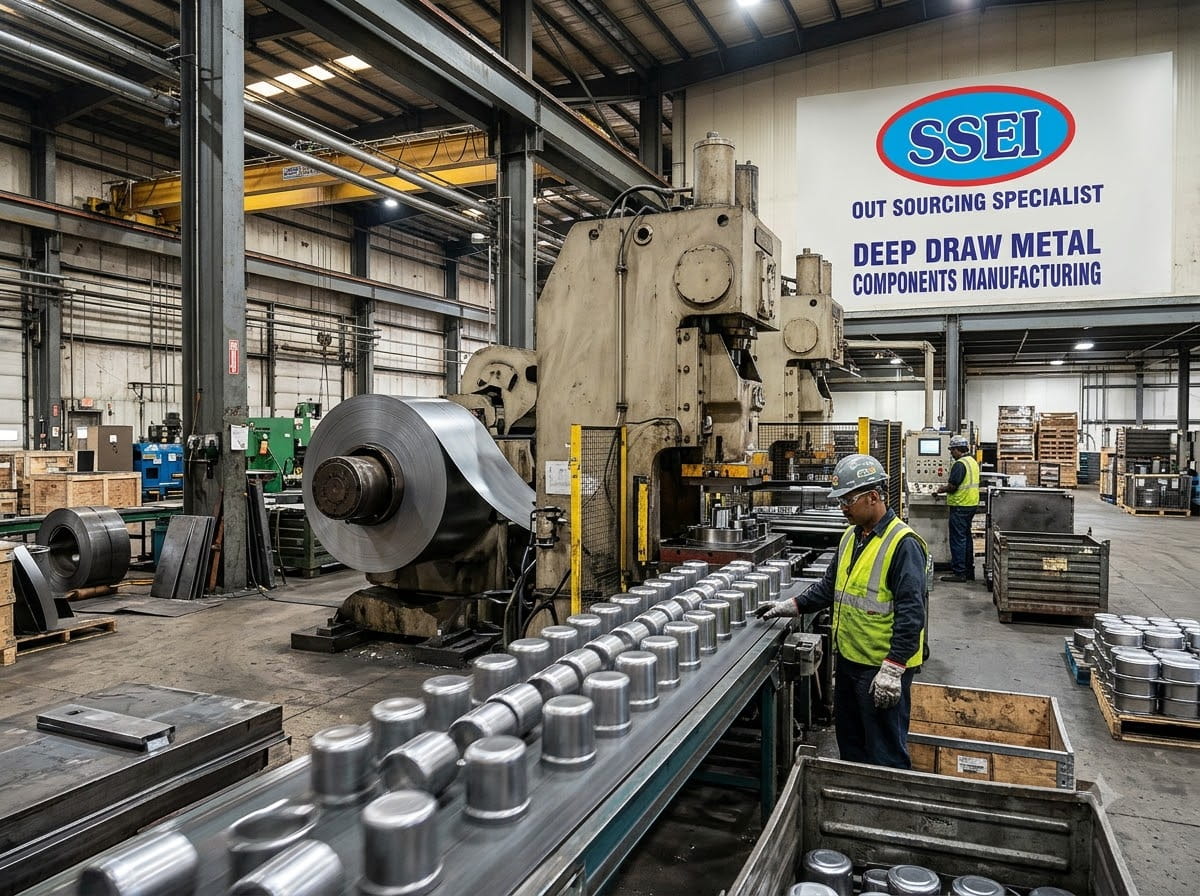
Need a seamless, hollow metal part that is strong, uniform and cost-effective at
volume?
Chances are it is a deep drawn component. Deep draw metal components manufacturing turns a flat
sheet into cups, shells, housings and containers in a single forming operation, without weld joints.
This guide explains how the process works, which materials suit it, where it is used and how to choose
the right deep draw parts manufacturer.
What Are Deep Draw Metal Components?
Deep draw metal components are hollow, seamless parts formed by pulling a flat sheet
metal blank into a die cavity using a punch. A part is generally called "deep drawn" when its depth is
equal to or greater than its diameter. Because the shape is formed from one piece of metal, there are
no welded seams, which improves strength, leak resistance and appearance.
Common examples include cylindrical cups, rectangular boxes, caps, shells, canisters
and
housings used across automotive, electrical, process and consumer industries.
How Does the Deep Drawing Manufacturing Process Work?
The deep drawing process follows a clear sequence:
- Blanking – a flat blank of the required size and shape is
cut
from sheet or coil
- Lubrication – a drawing lubricant is applied to reduce
friction and protect the tooling and the part surface
- Clamping – a blank holder presses the blank edge against the
die to control metal flow and prevent wrinkles
- Drawing – the punch pushes the blank into the die cavity,
forming the walls and base of the part
- Redrawing – for deeper parts, the cup is drawn again through
smaller dies in multiple stages
- Annealing (if required) – work hardening between stages is
relieved by heat treatment so the metal can be drawn further without cracking
- Trimming and finishing – excess flange is trimmed, and the
part is cleaned, deburred, polished or coated as specified
The ratio between blank diameter and punch diameter, known as the draw ratio, decides
how many stages are needed. A deeper or narrower part usually needs more draws.
Different Types of Deep Drawn Metal Components
Deep drawing can produce a wide range of geometries:
- Cylindrical cups and shells – the most common deep drawn
shape
- Rectangular and box-shaped parts – enclosures, covers and
casings with corner radii
- Flanged components – cups with a rim for mounting or sealing
- Stepped and tapered parts – multi-diameter or conical
profiles
- Domed and hemispherical parts – end caps and reflectors
- Custom deep draw metal components – made to drawing or
sample for specific assemblies
Materials Used in Deep Drawing
Deep drawing needs ductile metals that stretch without tearing. Common choices are:
| Material |
Why It Is Used |
| Low Carbon / Mild Steel |
Good formability, strength and low cost |
| Stainless Steel (304, 316) |
Corrosion resistance and hygiene, though it work-hardens quickly |
| Aluminium |
Lightweight, corrosion resistant and easy to draw |
| Brass |
Excellent drawability, good conductivity and finish |
| Copper |
High electrical and thermal conductivity |
Sheet thickness, grade and temper all affect how far a material can be drawn, so the
material should be confirmed together with the part design.
Deep Drawing vs Conventional Sheet Metal Stamping
Both processes use presses and dies, but they suit different parts:
| Factor |
Deep Drawing |
Conventional Stamping |
| Typical shape |
Seamless hollow parts (cups, shells, boxes) |
Flat or shallow parts, brackets, blanks |
| Forming action |
Draws and stretches the sheet into depth |
Cuts, punches, bends or shallow-forms |
| Joints / welds |
None needed, single-piece part |
May need welding for hollow shapes |
| Tooling complexity |
Higher, needs careful die and draw design |
Generally simpler |
| Best for |
Strong, leak-resistant, uniform-wall components |
Flat and lightly formed components |
If your part is a hollow shape that would otherwise need welding, deep drawing is
usually the better route. For flat or lightly formed parts, see our
sheet metal parts manufacturer and
pressing parts manufacturer pages.
Industries Using Deep Drawn Components
- Automotive – housings, caps, sleeves and fluid-system
components
- Electrical and electronics – enclosures, cans, terminals and
covers
- Lighting – reflectors, lamp bodies and holders
- HVAC and refrigeration – compressor shells, fittings and
covers
- Pumps, valves and process equipment – casings, caps and
containers
- Medical and pharmaceutical – stainless steel containers and
housings
- Kitchenware and consumer goods – cookware, utensils and
appliance parts
Factors Affecting Deep Drawn Component Quality
Good deep drawn parts depend on controlling several variables together:
- Material grade and thickness – consistent formability avoids
cracks and thinning
- Draw ratio and number of stages – too aggressive a draw
causes
tearing
- Die and punch design – correct radii and clearance protect
wall
thickness and surface finish
- Blank holder force – too little causes wrinkles, too much
restricts flow and causes tears
- Lubrication – reduces friction, galling and tool wear
- Annealing – restores ductility between draws on
work-hardening
metals
- Press selection and tool maintenance – stable tonnage and
well-maintained tools give repeatable results
- Inspection – dimensional, wall-thickness and surface checks
catch defects early
How to Choose a Deep Draw Manufacturing Partner
When evaluating a deep draw parts manufacturer, look for:
- Experience with your material and part geometry
- In-house or well-managed tooling design and die making
- Ability to support prototypes as well as volume production
- Clear quality checks and inspection practices
- Secondary operations such as trimming, machining, welding,
polishing
or plating
- Responsive technical communication and realistic lead times
To get an accurate quote, share:
- Part drawing, CAD file or sample
- Material and sheet thickness
- Dimensions and tolerances
- Surface finish or coating requirement
- Annual and batch quantities
- Application and operating conditions
Conclusion
Deep drawing is one of the most efficient ways to make strong, seamless, uniform metal
components at volume. The right result comes from matching the material, draw design, tooling and
quality control to the part's function. Shiv Sai Export & Import supports custom deep draw
metal
components based on your drawing, sample and application, through our network of manufacturing
partners. Explore our Deep Draw Parts Manufacturer page, or
send your requirement through our contact page for a quotation.
Also explore: sheet metal parts, pressing parts and precision machining parts.
Frequently Asked Questions
1. What are deep draw metal components?
Deep draw metal components are seamless, hollow parts formed from a flat sheet metal blank by drawing
it into a die with a punch. The depth of the part is typically equal to or greater than its diameter,
which is what separates deep drawing from shallow drawing.
2. Which materials are commonly used for deep drawing?
Low carbon steel, stainless steel (such as 304 and 316), aluminium, brass and copper are commonly deep
drawn because they offer good ductility and formability. The right choice depends on strength,
corrosion resistance, weight and cost requirements.
3. What is the difference between deep drawing and sheet metal stamping?
Conventional stamping mainly cuts, bends or shallow-forms sheet metal, while deep drawing stretches
and
draws the sheet into a seamless, three-dimensional hollow shape. Deep drawing is preferred for cup,
shell, box and cylindrical parts that need uniform walls and no weld joints.
4. Is deep drawing suitable for high-volume production?
Yes. Once the tooling is made, deep drawing delivers consistent parts at a low cost per piece, which
makes it well suited to medium and high-volume OEM requirements.
5. What information is needed for a deep draw component quotation?
A drawing or sample, material and thickness, dimensions and tolerances, surface finish, annual and
batch quantities, and application details help in evaluating a quotation.